




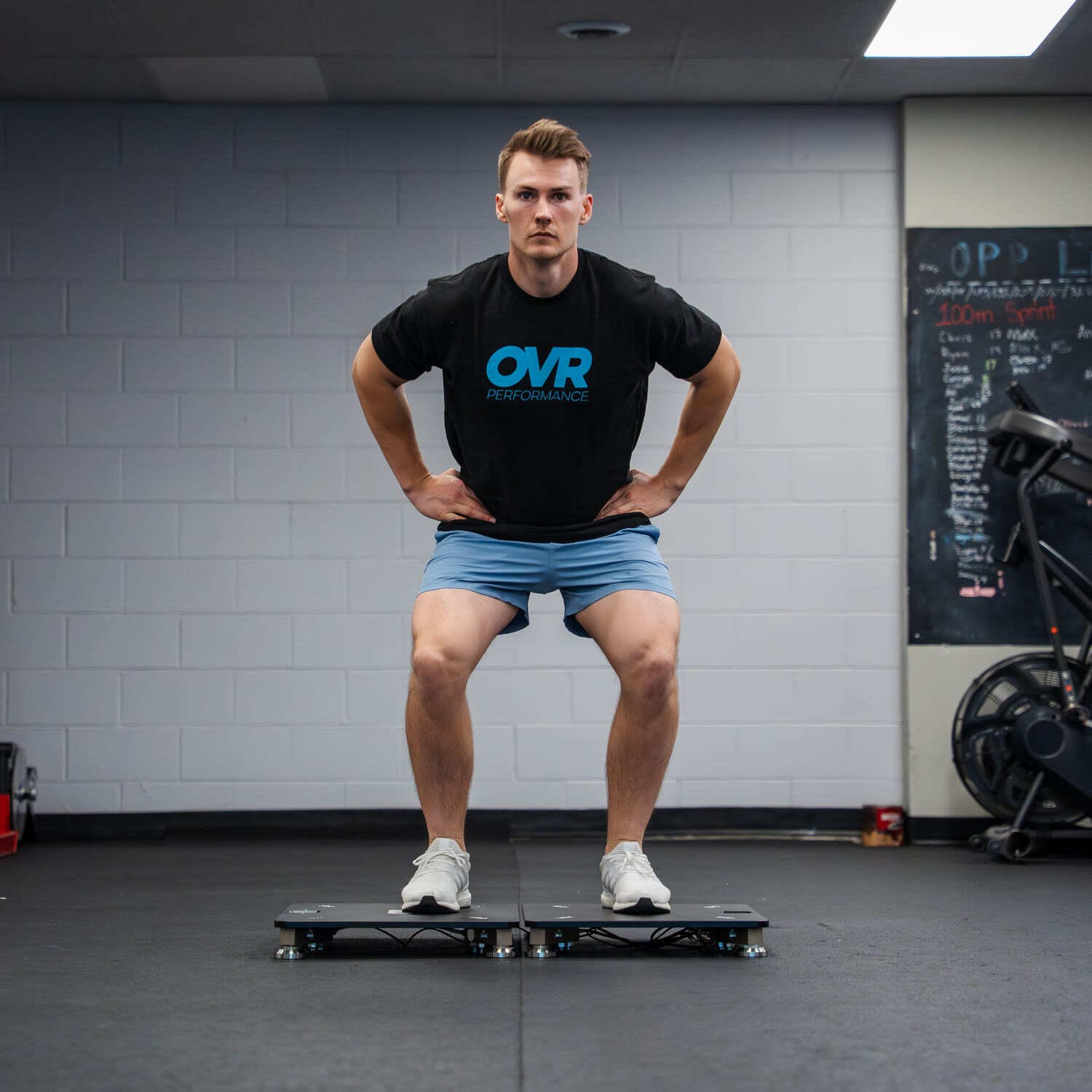
A weekly countermovement jump on a force plate is enough to monitor athlete readiness and fatigue, even when you are the strength coach, the analyst, and the data department all at once. You do not need daily testing, a sports scientist, or a stats degree. You need a fixed day, two or three numbers, and a plan for what changes when one drops.
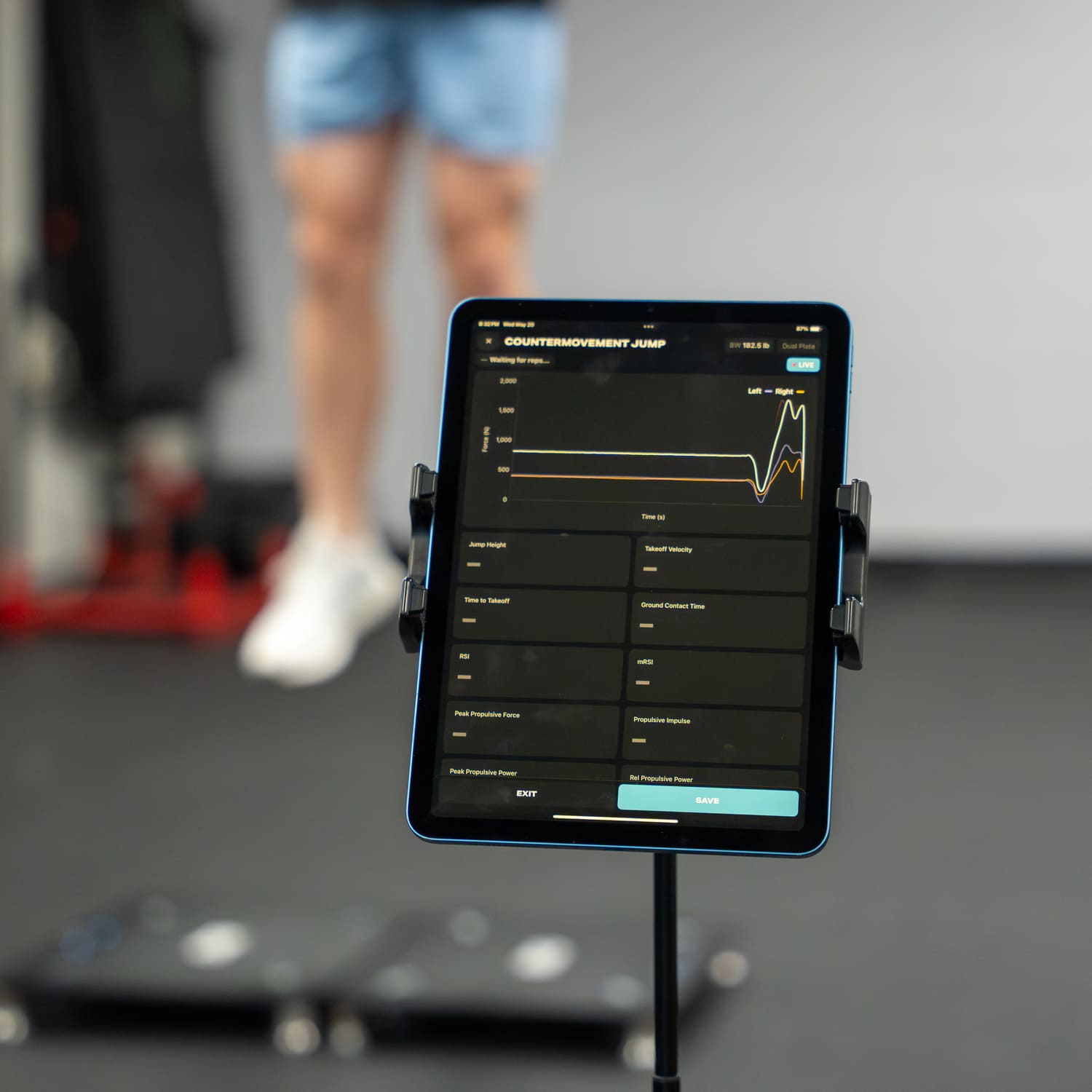
A force plate captures the full force-time curve from a single rep, so one jump gives you the outcome (how high they got) and the strategy (how they produced it). That second part is what separates force plate testing from a jump mat, and it is most of why a weekly check works.
What a weekly check catches
A weekly CMJ reads accumulated fatigue, not how sore an athlete feels at the door. Neuromuscular fatigue after a hard game or session commonly lingers 24 to 72 hours. So if your athletes play Saturday, a Monday test reads where they actually are before you load the next block.
Be honest about the ceiling: a weekly test will not catch a spike that shows up Wednesday and clears by Thursday. That is fine. The multi-day window is where most of your load decisions live.
Pick two or three numbers and ignore the rest
A force plate hands you plenty of metrics. Watch a few.
Start with jump height. It is stable day to day and easy to explain, but it can lie by omission. Athletes defend their height by lengthening the eccentric and concentric phases of the jump, so output looks recovered while the strategy producing it is still fatigued. Height drops in the first day or two after a hard bout, then in the 48-to-72-hour window it can read normal while the underlying strategy is still off.
So pair height with a strategy number. The cleanest one is mRSI, the modified reactive strength index: jump height divided by time to takeoff. It tells you how much jump an athlete got per unit of time spent loading it, and it tends to slide while jump height still looks fine. That early dip is the fatigue signal you want. (mRSI is the countermovement-jump version of reactive strength index and is not the same number as drop-jump RSI, so do not treat the two as interchangeable.)
One stable output number, one sensitive strategy number. Leave the rest of the dashboard alone.
Telling a real drop from a normal off day
Build the baseline from the weekly test itself. Run the same jump for four to six weeks of normal training, and the spread of those numbers is that athlete's range. Compare every new result to their own range first, and only then to group norms. Those weekly numbers become the start of an individual athletic profile you read against each week.
The no-math rule: every athlete has a normal week-to-week wobble. A change inside it is noise; a change clearly outside it is a signal. If an athlete's height sits between 26 and 28 cm across normal weeks, a 24 is worth acting on and a 27 is not. No z-score, no borrowed 5% rule. And average the trials, do not take the best jump.
Standardize it or the comparison is worthless
A weekly comparison only holds if the conditions stay identical:
- Same day, same time.
- Same warm-up, with nothing fatiguing right before the test.
- Hands on hips. Arm swing adds 10% or more to height and varies rep to rep.
- Three trials, about 60 seconds rest, averaged.
- Same device and method for an athlete's entire record.
The plate also gives you a number an athlete cannot talk their way around. A tired player who wants to train will say they feel fine. The jump shows you what their legs actually have that day.
What you actually change when the number drops
This is the part most monitoring content skips. Picture a Monday after a Saturday game, three athletes flagged. One also has terrible sleep and heavy legs, so you cut their volume. One sits right at the edge of their normal swing with nothing else off, so you call it likely noise, run them as planned, and watch the next test. One has flagged two weeks running, so you pull intensity and reassess. Same flag, three different calls.
How hard you pull back tracks two things: how far outside the range the number sat, and how much else agrees with it. A reading just past the edge with a good night of sleep behind it is a light touch or nothing at all. A big drop that lines up with a rough week and heavy legs is a real cut.
A flag is not an automatic day off. Cross-reference it against wellness (sleep, soreness, stress) and session-RPE first, then talk to the athlete. The number starts the conversation, it does not end it. When it holds up, modify rather than cancel. Treat it as in-season load management, adjusting today's dose, not abandoning the week:
- Cut volume. Same lifts, fewer sets. Start here unless the athlete is clearly buried.
- Drop intensity. When the systemic cost is the worry, not the work itself.
- Swap to quality work. Technical work, mobility, or low-volume speed and power.
- Full deload or rest. Only when the jump, the wellness check, and your eyes all agree.
The two numbers can also tell you which lever to pull. If jump height and mRSI drop together, the athlete is down on output across the board, so cut volume or hold them out. If jump height holds but mRSI slides, the engine is fine and the strategy is slowing, which is the classic early-fatigue pattern, and dropping intensity while keeping the movement crisp usually clears it in a session or two. Reading the pair beats reading either one alone, and it turns a vague red flag into a specific call you can defend to the athlete and the head coach.
Monitoring does not automate your coaching. It gives you an objective reason to look harder before you load an athlete, and a defensible basis for the change.
Why weekly is enough
Weekly testing is a credible readiness check in its own right. It matches the 24-to-72-hour recovery window most load decisions turn on, and it fits a real coaching week. Pick a fixed day, run three jumps per athlete, log the average, and let four to six weeks build each athlete's range. Done the same way every week, that is enough to manage a roster you are handling on your own.
Sources
- Gathercole et al. 2015, IJSPP 10(1):84-92: https://pubmed.ncbi.nlm.nih.gov/24912201/
- Cormack et al. 2008 (reliability), IJSPP 3(2):131-144: https://www.fittech.com.au/docs/Cormack-et-al.--2008-.-Reliability-of-single-and-repeated-CMJ%20-%20IJSPP.pdf
- Kennedy & Drake 2017, J Sports Med Phys Fitness: https://pubmed.ncbi.nlm.nih.gov/28085126/
- Roe et al. 2016, IJSPP: https://pubmed.ncbi.nlm.nih.gov/26390328/
- Claudino et al. 2017, J Sci Med Sport: https://pubmed.ncbi.nlm.nih.gov/27663764/
- Ebben & Petushek 2010, JSCR: https://pubmed.ncbi.nlm.nih.gov/20634740/
- Etiology and Recovery of Neuromuscular Fatigue following Competitive Soccer Match-Play: https://www.ncbi.nlm.nih.gov/pmc/articles/PMC5661001/
- Science for Sport, "Countermovement Jump (CMJ)": https://www.scienceforsport.com/countermovement-jump-cmj/
- Science for Sport, "Monitoring Fatigue": https://www.scienceforsport.com/monitoring-fatigue/
- Science for Sport, "Smallest Worthwhile Change": https://www.scienceforsport.com/smallest-worthwhile-change/
- SimpliFaster, "Developing an Athlete Monitoring Program with Jump Data": https://simplifaster.com/articles/athlete-monitoring-program-jump-data/
- Kinvent, "Mastering the Countermovement Jump": https://kinvent.com/blog/mastering-countermovement-jump/
- Adam Virgile, "Using Wellness Questionnaires in Sport": https://adamvirgile.com/2019/04/22/everything-you-need-to-know-about-using-wellness-questionnaires-in-sport/
- Arm swing contribution to CMJ height, Biomechanics (MDPI) 2025: https://www.mdpi.com/2673-7078/5/3/45

Leave a comment
This site is protected by hCaptcha and the hCaptcha Privacy Policy and Terms of Service apply.