




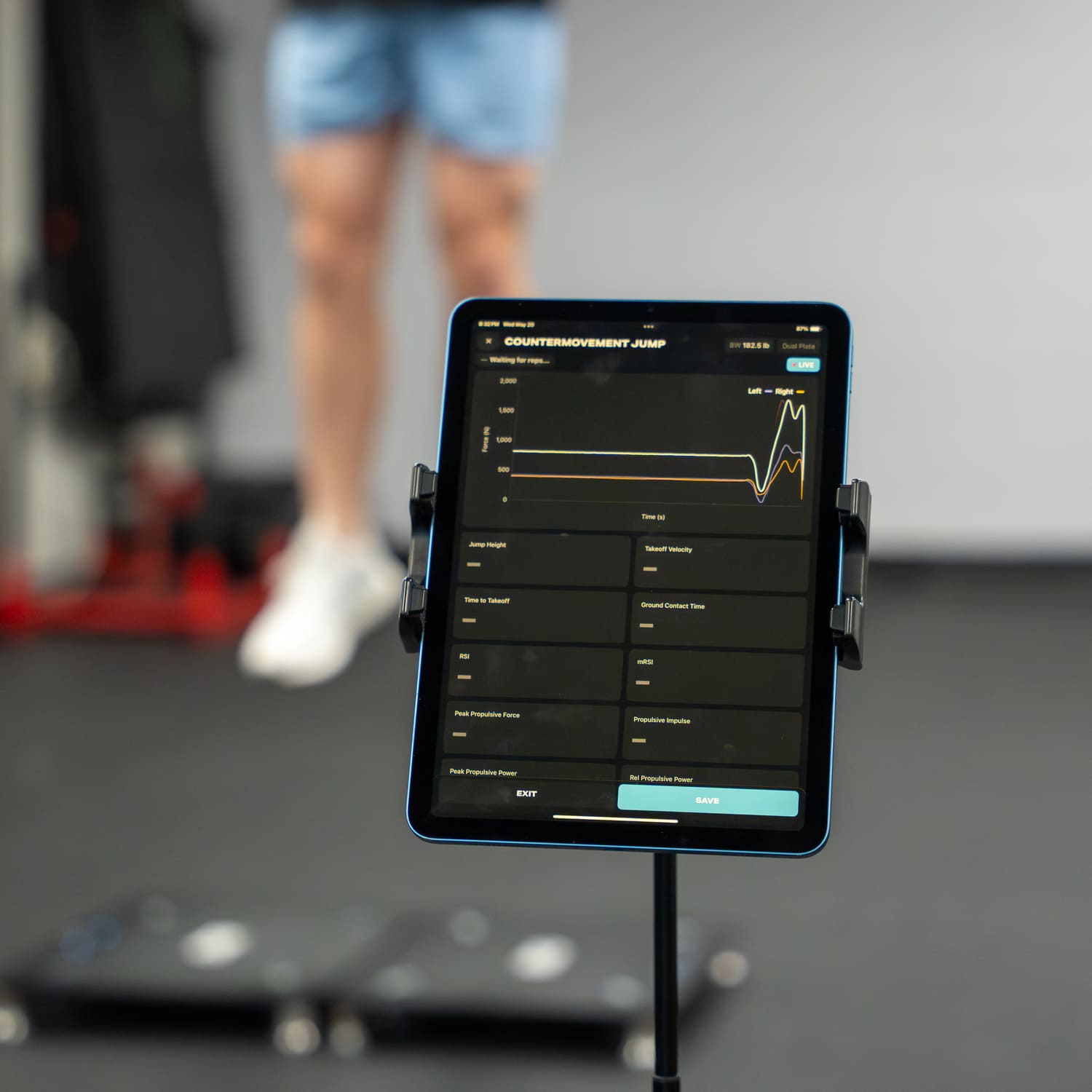
A baseline profile is an athlete's own normal range across a handful of metrics, measured the same way over several sessions. Once you have it, a force plate tells you whether today's number is a real change or just the scatter every athlete shows. All it takes is a standalone force plate, a roster, and a test you run the same way every time.
The Personal Baseline Is the Standard
Published norms place an athlete in a group. A 16-year-old whose hands-on-hips jump comes in at 16 inches sits about average for their age, which is useful context but not what you train against. The reference that matters is their own normal, because what counts as a real change is set by their own testing variation, not by where they rank.
You are comparing each athlete to themselves. That holds whether they are a returning starter or a freshman who joined last week. The norm tells you roughly where they stand. The baseline tells you when they have actually moved.
Build a Profile From Metrics That Repeat
One jump is insufficient for a full profile. A baseline worth keeping spans the qualities you actually train: power from a countermovement jump (jump height, mRSI, relative power), maximum strength from an isometric mid-thigh pull (relative peak force), reactive ability from a drop jump (RSI), and side-to-side asymmetry if you run two plates. Together they give you the full athletic profile: power, strength, and reactive ability in one picture.
Baseline only the metrics that repeat. Every metric has a coefficient of variation, or CV: the percent it swings session to session when nothing has changed. Peak outputs are steady. Within a session, CMJ jump height swings about 6%, peak force and power lower still, drop-jump RSI 2 to 3%. Between sessions on a real roster the swing is wider, 5 to 9% on jump height, and that is the noise you actually have to clear day to day. Skip the jittery readings: raw peak RFD and time to peak force can bounce 20 to 30% between trials, so a single number means little. The smoothed RFD the plate reports is steady enough to track. It is the raw, single-instant version that jumps around.
Standardize the Test or the Baseline Is Fiction
Change the conditions and you stop measuring the athlete and start measuring the conditions. A few things drift your numbers enough to wreck a baseline, whichever test you run.
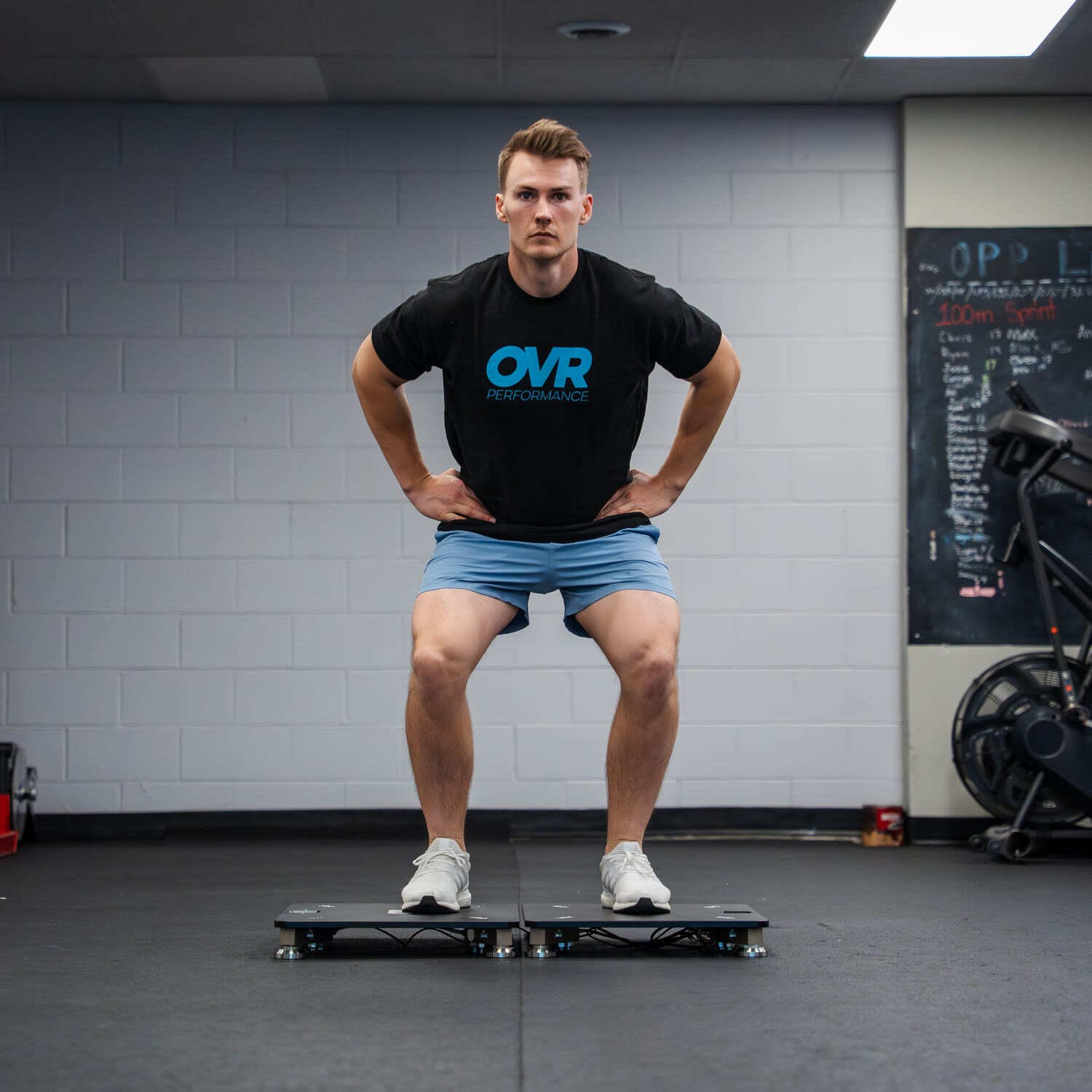
- Arm swing. On any jump, letting the arms go inflates height 10 to 20%, and the boost varies from athlete to athlete, more in younger or less coordinated jumpers. Run the monitoring jump with hands on hips, every time.
- Time of day. Most outputs run a few percent higher in the late afternoon than the morning, about 4 to 6% on jumps. Test at the same time, and hold the same warm-up, since a longer warm-up closes most of that gap.
- The per-test setup. Same cue, same footwear, same surface. Same box height on a drop jump, same bar height and stance on a mid-thigh pull. Set the recommended joint angles once, then repeat them: hitting the exact textbook position matters less than landing on the same setup the athlete used last time.
How Many Trials, How Many Days
Run three valid reps, about 30 seconds apart, or 45 to 60 seconds when you are running more reps or testing a tired athlete, since too little rest reads as false fatigue. If one rep sits more than 5% off the other two, toss it and take another. For a baseline you monitor against, trend the mean of the valid reps: it is steadier session to session and drops with fatigue before the best rep does. Keep the best valid rep too, as the running benchmark. That PR shows up on its own across regular testing, so there is no separate max-out day.
One session is not a baseline. Numbers swing more between days than within one, so build the baseline across several days inside a couple of weeks. Younger or less-trained athletes are noisier at first. Expect a freshman's first week to be teaching reps, and do not trust their numbers until they stop drifting.
Tell a Real Change From Noise
The question is simple: is today's number outside their normal swing or inside it? After two or three weeks, eyeball their range on normal weeks. If their jump sits around 16 inches and bounces about half an inch either way, a drop to 14 means something. Write that range next to their baseline and read every metric, jump height, peak force, or reactive strength index, against its own swing the same way.
Until you have that range, lean on the metric's own noise as a starting default. A dip about the size of one CV, roughly 5 to 6% on jump height, is normal scatter, not a signal. A drop clearly past that, around 10% or more on a reliable metric, is a confident action level: not a magic number, but a change clearly outside the normal range. Once you know a well-trained athlete's actual swing, their real threshold may sit tighter than the blanket 10% rule assumes. A clear drop should prompt a lighter day or a conversation about sleep and load.
This is where one plate and no analyst is genuinely enough. You are not running statistics, you are doing what a good coach already does by eye, except the plate gives you the number instead of a guess, and over a few weeks it teaches you how much each athlete bounces. That makes self-testing realistic on a big roster: load the athletes, set the plate on a stand, and let them test themselves once they have a couple of weeks of practice.
One caution on jump height: a clear drop is a real fatigue flag, but a flat number does not mean fresh. A tired athlete can hold their height by dipping deeper and slower, a change the number hides. For week-to-week fatigue, the strategy metrics move first: how long the jump takes, how fast they reverse at the bottom. The full baseline is what makes any of those reads possible.
Keep the Baseline Alive
A baseline is the start of a loop. You measure future sessions against it, and since the athlete changes across a season, you re-baseline at phase boundaries: the start of off-season, the start of pre-season, after a layoff.
Pick a small set you will actually repeat: a hands-on-hips jump weekly, one strength test every two to four weeks. A long list of tests is the first thing you drop when the week gets busy, and an out-of-date baseline will not help you. Build it right, with reliable metrics, standard conditions, and enough reps across enough days, and one plate turns a roster of guesses into numbers you can read.
Sources
- Global Performance Insights, Smallest Worthwhile Change: https://www.globalperformanceinsights.com/post/smallest-worthwhile-change-interpreting-meaningful-change-in-athlete-monitoring
- Countermovement Jump Analysis Using Different Portable Devices (Sports/MDPI 2018), PMC6162675: https://pmc.ncbi.nlm.nih.gov/articles/PMC6162675/
- Reliability and Test-Retest Agreement of Mechanical Variables Obtained During CMJ, PMC7039490: https://pmc.ncbi.nlm.nih.gov/articles/PMC7039490/
- Reliability of Vertical Jump Force-Time Metrics in Collegiate Athletes vs Recreationally Active Individuals, PMC12733763: https://www.ncbi.nlm.nih.gov/pmc/articles/PMC12733763/
- The Effect of Altering Body Posture and Barbell Position on Between-Session Reliability of IMTP Force-Time Characteristics, PMC6316399: https://www.ncbi.nlm.nih.gov/pmc/articles/PMC6316399/
- Cormack SJ et al., Reliability of Measures Obtained During Single and Repeated Countermovement Jumps, IJSPP 2008: https://journals.humankinetics.com/view/journals/ijspp/3/2/article-p131.xml
- Influence of Familiarization and Competitive Level on the Reliability of CMJ Variables, PubMed 26398700: https://pubmed.ncbi.nlm.nih.gov/26398700/
- Byrne et al., The Intraday Reliability of the Reactive Strength Index Calculated From a Drop Jump in Professional Men's Basketball, IJSPP 2015: https://journals.humankinetics.com/view/journals/ijspp/10/4/article-p482.xml
- Interday Reliability of the Reactive Strength Index and Optimal Drop Height, JSCR 2017: https://journals.lww.com/nsca-jscr/fulltext/2017/03000/interday_reliability_of_the_reactive_strength.18.aspx
- MDPI Biomechanics 2025, Assessing the Contribution of Arm Swing to CMJ Height: https://www.mdpi.com/2673-7078/5/3/45
- Frontiers in Physiology 2018, Diurnal Variation of Short-Term Repetitive Maximal Performance: https://www.frontiersin.org/journals/physiology/articles/10.3389/fphys.2018.01499/full
- Robinson et al., Warm-Up Affects Diurnal Variation in Power Output, PubMed 21305444: https://pubmed.ncbi.nlm.nih.gov/21305444/
- Science for Sport, Countermovement Jump (CMJ): https://www.scienceforsport.com/countermovement-jump-cmj/
- SimpliFaster, Making Elite Tech Accessible: How to Use Force Plates at the High School Level: https://simplifaster.com/articles/hawkin-force-plates-high-school-athletes/
- SimpliFaster, Everything You Need to Know About the Countermovement Jump on Force Plates: https://simplifaster.com/articles/countermovement-jump-force-plates-guide/
- Training & Conditioning, How to Use Force Plates in Sports: https://training-conditioning.com/news/how-to-use-force-plates-in-sports/
- Carepatron, Isometric Mid-Thigh Pull Test (IMTP reliability synthesis): https://www.carepatron.com/templates/isometric-mid-thigh-pull-test


Leave a comment
This site is protected by hCaptcha and the hCaptcha Privacy Policy and Terms of Service apply.