




A good force plate gives you a focused set of numbers worth acting on, and seven of them cover most of your everyday coaching decisions. Learn these seven first, point your attention there, and layer in the rest as you get comfortable. Any coach can read them on their own.
The first four (jump height, mRSI, relative peak force, and relative peak power) are the starter set: one for how high, one for how efficiently, one for how strong, one for how powerful. The last three add depth once those are part of your weekly rhythm.
The filter
A metric earns its place when a change in it changes what you program. A focused handful clear that bar, the steady numbers that tell you what to do next.
Two kinds matter. Outcome metrics (like jump height) tell you whether performance moved. Strategy metrics (time to takeoff, the strength-to-power ratio) tell you why and what to change next. You want both, which is why coaches read jump, sprint, and strength data together.
Jump height: did the block work
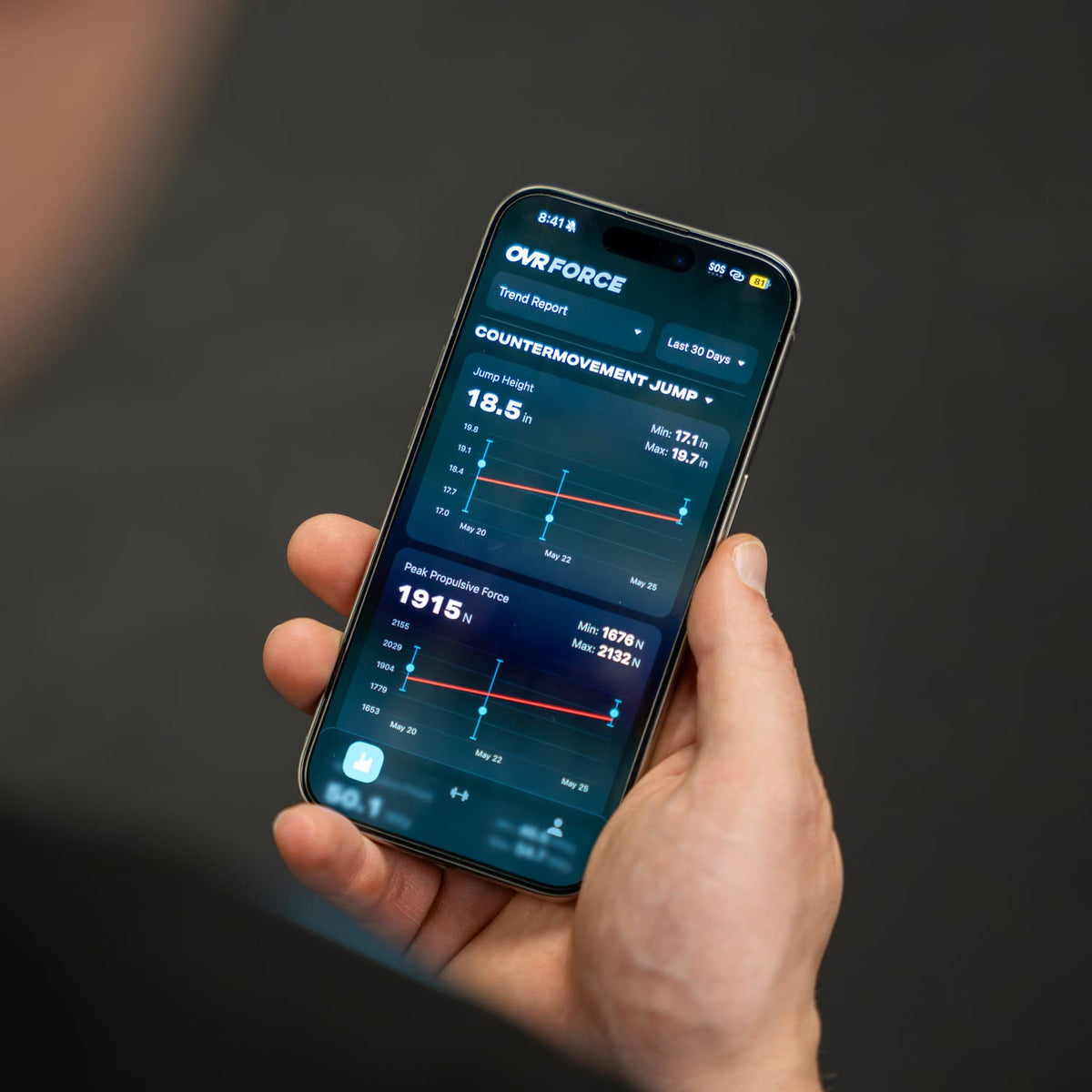
Jump height from a countermovement jump is your cleanest outcome number, and the most misread. It tells you whether the last block raised the ceiling. Read it as a slow trend over weeks.
What the number captures is the result of the entire movement, how high the center of mass rose. The classic mistake is to credit that height to peak force, the single hardest push into the plate. A brief spike of force adds little by itself. What launches the body is impulse, force above bodyweight applied across the whole push-off, and the longer that force keeps acting, the more takeoff speed it builds. Takeoff speed sets the height. In Kirby and McBride's work, impulse tracked jump height almost perfectly (r = 0.925), while peak force on its own was far less related, even trending the opposite way (r = -0.408).
mRSI and time to takeoff: catch fatigue early
Jump height lags fatigue. A tired athlete can still hit the same height by taking longer to produce it, and modified reactive strength index (mRSI) is the number that exposes that slowdown.
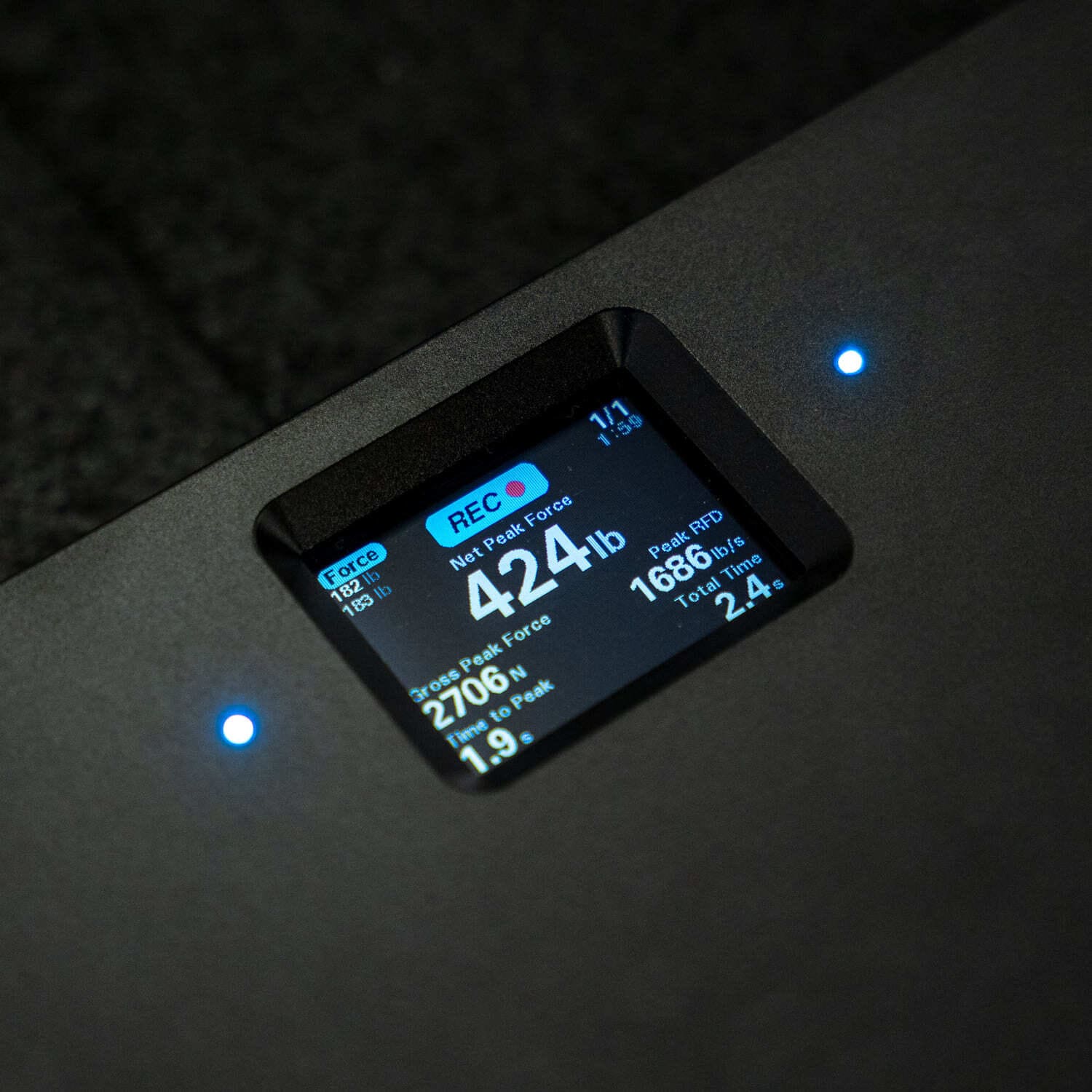
Time to takeoff is the whole time on the plate, from the start of the dip to the feet leaving, about 0.7 to 0.9 seconds. mRSI is jump height divided by that time, so it rewards jumping high and getting it done quickly. When fatigue stretches the time out, mRSI falls even though the height held, which makes it the earlier warning. The OVR Force shows the number on its screen the moment the athlete lands, so you catch the dip and pull volume or deload before performance itself drops. Test one to two jumps a week at a fixed time, average three trials, keep the setup identical.
One naming trap: mRSI and RSI are different metrics. mRSI uses time to takeoff in a countermovement jump; RSI uses ground contact time in a rebound off a box and runs several times shorter. If reactive bounce is what you want to train, you build it with RSI-guided plyometric work.
Relative peak force and force at 100 ms: maximal and explosive strength
For maximal strength, track relative peak force from an isometric mid-thigh pull (IMTP), an all-out pull against a fixed bar at mid-thigh. The plate subtracts bodyweight automatically, so the number is net force, the force you produce above just standing there. "Relative" means it is divided by bodyweight and reported as multiples of bodyweight, a fair comparison across athletes of differing size. It is the steadiest number the IMTP gives.
Pair it with force at 100 milliseconds, the force produced in the first tenth of a second, which is about the window a foot spends on the ground in a sprint. High peak force with low force at 100 ms marks the strong-but-slow athlete, who responds best to fast, explosive work over heavier lifting, a classic power versus strength call. That early-window number is only worth trusting because a good plate samples a thousand times a second; at a slower sampling rate the first tenth of a second is too coarse to read. Test the IMTP every two to four weeks.
Relative peak power: how powerful the athlete is
For lower-body power, track relative peak power off the same countermovement jump you already run for jump height and mRSI. Where jump height tells you how high the athlete got, power tells you how hard they drove to get there, and it is the cleanest single read on power across athletes of different sizes.
Power is force multiplied by velocity, so it captures both how much force goes into the ground and how fast it is applied. The plate takes that product across the push-off, reports the peak, and divides it by bodyweight to give watts per kilogram (W/kg), the standard power unit in strength and conditioning. That puts a 75 kg guard and a 110 kg lineman on the same scale. On the OVR Force this metric is Relative Propulsive Power.
Track the per-bodyweight number, not raw watts, which mostly rewards being big. And read it as a slow trend across blocks rather than week to week: it is steady, so a climb is the sign your ballistic and speed-strength work is landing.
DSI: strength or power, which to train next
Dynamic strength index (DSI) is the peak force from a jump's push-off (peak propulsive force) divided by the peak force from a maximal isometric pull (the IMTP). You run both tests already, so you have both numbers. Use total force on both sides, bodyweight included, or the ratio gets thrown off. Read it within one athlete over time:
- Under 0.60: strong but cannot express it dynamically. Add ballistic, plyometric, contrast work.
- 0.60 to 0.80: balanced. Train to general needs.
- Above 0.80: already turns strength into speed well, so more raw strength is what raises the ceiling. Lean into heavy work.
DSI is steady, so trust the trend over weeks. It is the fastest what-do-I-train-next number on the plate, and it answers one question well: whether the athlete needs more strength or more ability to express it quickly. That is why it earns a slot even though it takes two tests to produce.
Asymmetry: your earliest bilateral warning
Asymmetry is the gap between an athlete's left and right side, shown as a percentage, and it is the backbone of nearly every return-to-play decision. The braking phase, the bottom of the dip where the athlete stops falling and reverses to drive up, is the one to lead with. Deceleration is the first quality a returning or fatigued athlete protects, so a gap shows up there before it reaches propulsion or landing, often while jump height still looks even. If you follow only one asymmetry number, follow braking asymmetry.
The size of the gap is only part of the picture. Two athletes can both read 12 percent and need opposite programs, because where the gap sits and which way it leans matter as much as how big it is. So name the phase it came from and read its direction alongside the magnitude. As a screening guide, treat 0 to 10 percent braking asymmetry as on track, 10 to 15 percent as worth a closer look, and above 15 percent as worth a deeper one. No validated force-plate cutoff exists, so use these zones to point your attention and let the treating clinician own any clearance call.
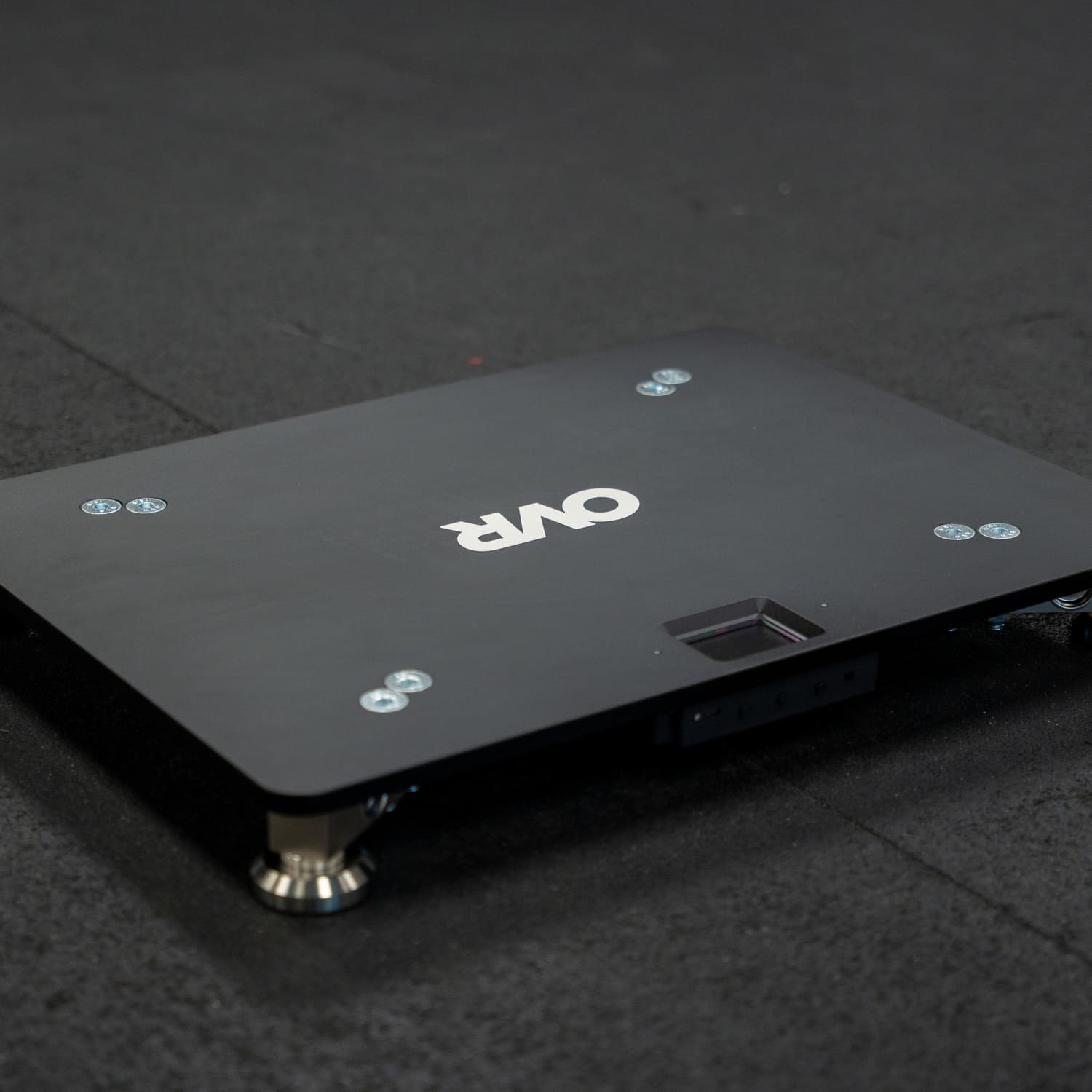
Two practical notes. A bilateral jump lets an athlete quietly lean on the stronger leg, so a single-leg test gives the truer limb-by-limb read when you need it. And asymmetry is the one metric here that needs two plates. Everything else works on a single OVR Force, so you can start with one and add the second when bilateral data becomes the priority.
Seven metrics, seven decisions
Run these seven on a fixed protocol:
- Jump height: did the block work.
- mRSI with time to takeoff: fatigue, before height drops.
- Relative peak force: maximal strength, the base under everything.
- Relative peak power: how powerful the athlete is for their size, and whether power blocks are working.
- Force at 100 ms: explosive strength, strong versus strong-and-fast.
- DSI: strength or power, which to train next.
- Asymmetry (braking phase, dual plate): which limb needs targeted work.
What turns these seven into decisions is consistency. Run them the same way every time, at the same point in the training week, and average a few trials so a single odd rep does not skew the read. That discipline is what separates a real change from day-to-day noise, and it is the difference between a number you act on and a number you second-guess. Track the seven that move your next session and let the rest sit.
The OVR Force makes that routine cheap to keep up with. It works without your phone, and the free OVR Connect app stores the trend with no subscription, so a re-test costs nothing but a few seconds and the history is always there to compare against. Force-plate testing like this used to be reserved for programs with a sport scientist on staff. Seven numbers and one plate put it in a normal coach's hands.
Sources
- Kirby, McBride et al. 2011, Relative Net Vertical Impulse Determines Jumping Performance, Journal of Applied Biomechanics 27(3): https://pubmed.ncbi.nlm.nih.gov/21844609/
- Reliability and Test-Retest Agreement of Mechanical Variables During the CMJ, PMC7039490: https://pmc.ncbi.nlm.nih.gov/articles/PMC7039490/
- Sayers et al. 1999, Cross-Validation of Three Jump Power Equations, Medicine and Science in Sports and Exercise 31(4): https://pubmed.ncbi.nlm.nih.gov/10211864/
- Haff and Nimphius 2012, Training Principles for Power, Strength and Conditioning Journal 34(6): https://journals.lww.com/nsca-scj/fulltext/2012/12000/training_principles_for_power.2.aspx
- Science for Sport, Rate of Force Development (RFD): https://www.scienceforsport.com/rate-of-force-development-rfd-2/
- Rate of Force Development as an Indicator of Neuromuscular Fatigue: A Scoping Review, PMC8301373: https://pmc.ncbi.nlm.nih.gov/articles/PMC8301373/
- Science for Sport, Dynamic Strength Index: https://www.scienceforsport.com/dynamic-strength-index/
- Comparison of Methods of Calculating the Dynamic Strength Index, PubMed 28714767: https://pubmed.ncbi.nlm.nih.gov/28714767/
- Reliability of the Dynamic Strength Index in College Athletes, PubMed 25393233: https://pubmed.ncbi.nlm.nih.gov/25393233/
- Bishop et al. 2019, Jumping Asymmetries Are Associated With Speed, Change of Direction, and Jump Performance in Elite Academy Soccer Players, PubMed 30707141: https://pubmed.ncbi.nlm.nih.gov/30707141/
- Bishop, Read et al. 2018, Interlimb Asymmetries: Understanding How to Calculate Differences, Strength and Conditioning Journal 40(4): https://journals.lww.com/nsca-scj/fulltext/2018/08000/interlimb_asymmetries__understanding_how_to.1.aspx
- Strength, Jumping, and Change-of-Direction Speed Asymmetries Are Not Associated With Athletic Performance in Elite Academy Soccer Players, PMC7063114: https://pmc.ncbi.nlm.nih.gov/articles/PMC7063114/
- Effects of Soccer Match-Play on Unilateral Jumping and Interlimb Asymmetry, PubMed 31985557: https://pubmed.ncbi.nlm.nih.gov/31985557/
- Dos'Santos, Comfort et al., Reliability of Biomechanical Variables During the IMTP and Isometric Squat and Reporting of Normative Data: https://www.researchgate.net/publication/325279433
- Comfort et al. 2019, Standardization and Methodological Considerations for the Isometric Mid-Thigh Pull, Strength and Conditioning Journal 41(2): https://www.researchgate.net/publication/328498794
- Gathercole et al., Alternative Countermovement-Jump Analysis to Quantify Acute Neuromuscular Fatigue: https://www.researchgate.net/publication/262939784
- Science for Sport, Reactive Strength Index: https://www.scienceforsport.com/reactive-strength-index/
- Output Sports, A Guide to the Reactive Strength Index (Flanagan applied benchmark): https://www.outputsports.com/blog/guide-to-reactive-strength-index
- Adam Loiacono, Force Plate Testing: Choosing Metrics and How to Improve Them: https://adamloiacono.com/force-plate-testing-choosing-metrics-and-how-to-improve-them/
- GymAware (Travis Mash), Practical Uses for the Dynamic Strength Index: https://gymaware.com/practical-uses-for-the-dynamic-strength-index/

Leave a comment
This site is protected by hCaptcha and the hCaptcha Privacy Policy and Terms of Service apply.