




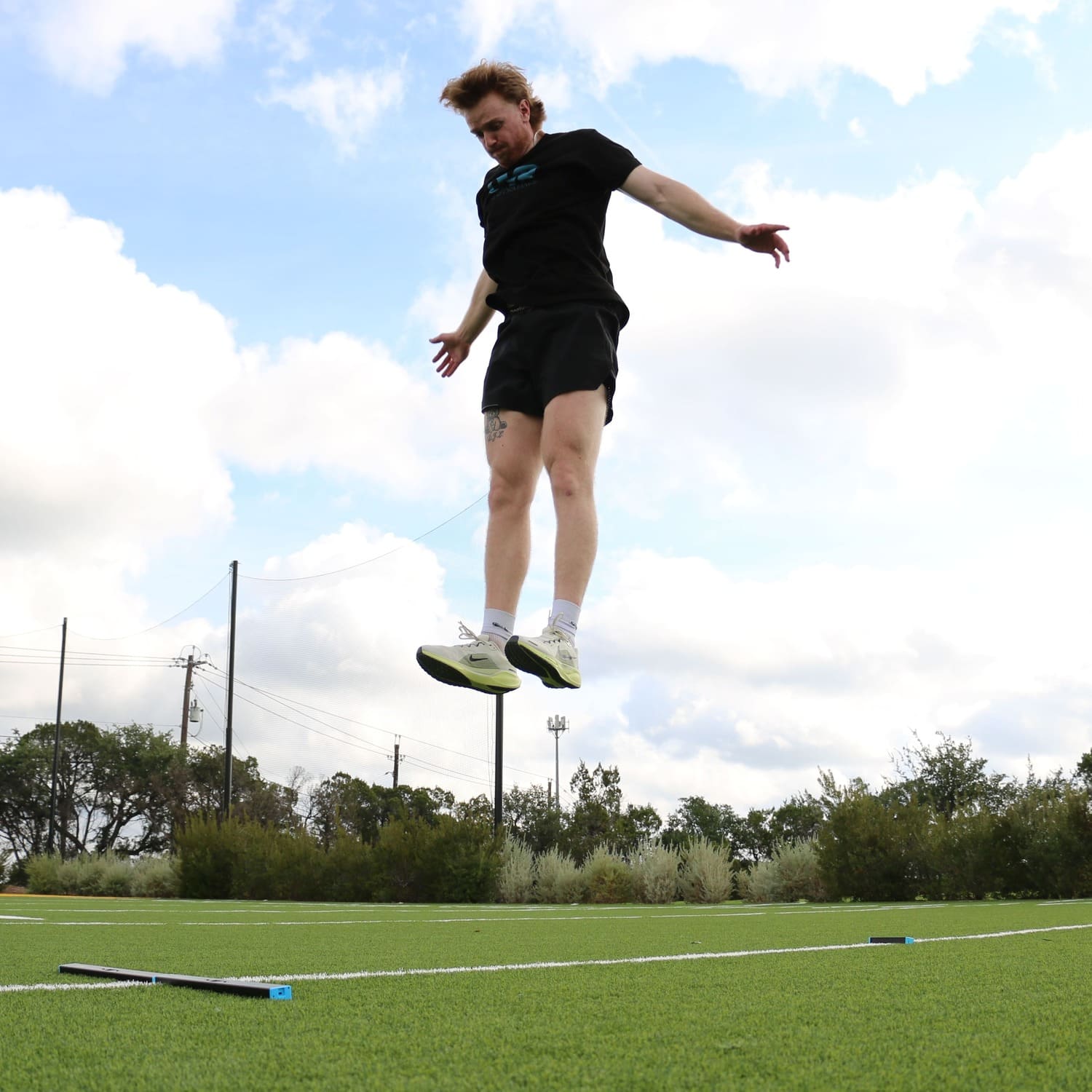
Speed testing should fit inside a practice, not take over one. The problem most coaches run into isn't the testing itself. It's the setup time, the equipment friction, and the line management that turns a 20-minute block into an hour. Modern timing gates solve most of that. No chips to distribute, no laser alignment headaches, no app required to see a time. Set up in under 60 seconds, run any number of athletes through, and the time flashes on the device the moment the beam breaks. This guide gives you a starting point for running clean, efficient testing sessions whether you have 5 athletes or 150.
How many gates do you need?
Two gates cover most situations. One start, one finish. That's your base kit and it handles everything from a 10-yard acceleration test to a 40-yard dash to a flying 10
Add a third gate and you pick up a split. A 0-10-40 yard setup, for example, gives you both acceleration and full-distance time in a single run. For most coaches, three gates is the practical sweet spot. Additional splits add devices to the total.
Four or more gates give you a more detailed picture of how an athlete accelerates across the full sprint. For most coaches, three gates is plenty to work with.
OVR Sprint supports up to 16 gates on a single channel, so you can scale up as your needs grow.
Understanding your setup options
Every OVR Sprint system has one Home device and can be paired with up to 15 Link devices. The Home device shows results, collects data from all connected Links, and connects to the app if you want it.
Single Mode auto-resets after each complete run. One athlete goes through, the time flashes, the system is ready for the next person. This is the go-to mode for two-gate setups on testing days because it keeps the line moving without any manual resets.
Split Mode records unlimited splits and requires a manual reset. It is what you use any time you have three or more gates in a sprint test, and it is also required for agility drills like the 5-10-5 where multiple gate passes are captured in one run.
OVR Sprint also has 10 independent channels, which means you can run multiple lanes in the same space without interference.
Rest between sprints
For quality data, athletes need enough recovery between efforts to reproduce a true maximal effort. [2] A common mistake on testing days is moving the athletes too quickly through the line. The times may look fine in the moment, but fatigue from earlier efforts tends to show up in the later trials in ways that are hard to account for after the fact. If you truly want to improve explosive power in their sprints, adequate rest should be standard and not an afterthought. For those rest periods, these are general guidelines to work from:
| Sprint distance | Suggested rest between trials |
|---|---|
| 10 yards | 30 to 60 seconds |
| 20 yards | 60 to 90 seconds |
| 40 yards | 2 to 3 minutes |
| 60 yards and up | 3 to 4 minutes or more |
When in doubt, a minute of rest per 10 meters or yards run is a simple coaching guideline that keeps you on the right side of recovery. [2, 3]
With larger groups, the line rotation tends to give athletes built-in rest without any deliberate management on the coach's part. By the time an athlete finishes a run and cycles back to the front of the line, enough time has usually passed to take another quality effort. With smaller groups that cycle faster, being more deliberate with rest is worth it.
Group size protocols
One set of gates is enough to get started, and for most sessions that is all you need. As a general recommendation, one lane per every 15 athletes helps keep sessions organized and rest intervals natural. If you want to run two lanes simultaneously, you need at least four devices: one start gate and one finish gate per lane. Each lane runs on its own channel, so there is no interference between them.
Small groups (1 to 15 athletes)
A single lane is the natural fit here and handles this group size comfortably. Run 2 to 3 trials per athlete and take either the best time or the average across efforts. If times are dropping significantly from one trial to the next, that is a sign athletes need more time between efforts. If times are holding steady, the rest is sufficient and you can keep things moving.
Medium groups (15 to 30 athletes)
At this range, two lanes keeps things running at a comfortable pace with rest intervals that feel natural for athletes. A single lane can still work depending on your time and setup, but adding a second lane is where the session starts to feel noticeably smoother. Move through the full group for one trial, then repeat.
Large groups (30 to 45 and up)
Three or more lanes is the recommendation here, with one lane per every 15 athletes as the general guideline. Each additional lane keeps rest intervals natural and prevents the line from becoming the bottleneck. That said, if space or equipment limits you to fewer lanes, one set of gates will still get the job done. For combine-style events, a sprint distance in one lane and an agility drill in another lets you run multiple stations simultaneously. Ten available channels means up to ten independent setups can run in the same space at once.
Start methods
In most testing situations, athletes simply set up and go when they are ready. OVR Sprint offers a few different start methods depending on the type of test you are running.
Flying Start: Athlete breaks the beam while already moving. Best for max velocity testing and flying 10 or 20 setups.
In-Beam Start: Athlete stands in the beam and steps out to begin. Timing starts on exit. Good for any situation where you want the clock to start on movement rather than when the athlete crosses the start gate.
Trigger Start: Coach taps a button on the Home device, gates beep, timing starts when the athlete breaks the first beam. Records reaction time.
Quick start tips
A few general recommendations that tend to produce cleaner data and more efficient sessions for an overall simpler and smarter way to measure speed.
Standardizing where athletes set up before each run is worth the extra 30 seconds. Being even slightly closer to the beam changes the time, and inconsistent start position is one of the more common sources of data drift across testing sessions. [4]
A 10 to 15 minute dynamic warm-up with 2 to 3 build-up runs before timed efforts is a good starting point. Athletes who are properly warm tend to produce more representative times and are at lower injury risk. [1]
When tracking progress over time, testing on consistent surfaces with consistent footwear helps keep comparisons meaningful. A time from a gym floor in trainers and a time from grass in cleats are measuring different things. [1, 3]
Recording 2 to 3 trials and taking the best or averaging across efforts is a reasonable approach. Research on 40-yard testing suggests performance can decline after the third or fourth rep even with rest periods, so prioritizing quality trials over total volume tends to serve coaches better on testing days. [2]
Closing thoughts
Sprint testing does not have to be a complicated production. One set of gates, a start and a finish, can meet almost any need. We recommend up to 15 athletes per lane as a practical guideline for keeping sessions organized and rest intervals manageable, though a single lane can handle more depending on your setup and time available. The protocols above are a starting point, and the best system is the one you will actually use consistently. Pick a distance, standardize your setup, and run it the same way every time. The data compounds over sessions, and that consistency is what turns a single time into something meaningful for your athletes.
References
- Haugen T, Buchheit M. Sprint running performance monitoring: methodological and practical considerations. Sports Med. 2016;46(5):641-656.
- Haff GG, Triplett NT, eds. Essentials of Strength Training and Conditioning. 4th ed. Champaign, IL: Human Kinetics; 2016.
- Haugen T, Seiler S, Sandbakk O, Tønnessen E. The training and development of elite sprint performance: an integration of scientific and best practice literature. Sports Med Open. 2019;5(1):44.
- Altmann S, Spielmann M, Engel FA, Neumann R, Ringhof S, Haertel S, Woll A. Validity of single-beam timing lights at different heights. J Strength Cond Res. 2017;31(7):1994-1999.

1 comment
Bill Carroll
How do I add my athletes names?
Thank you for your time
Leave a comment
This site is protected by hCaptcha and the hCaptcha Privacy Policy and Terms of Service apply.